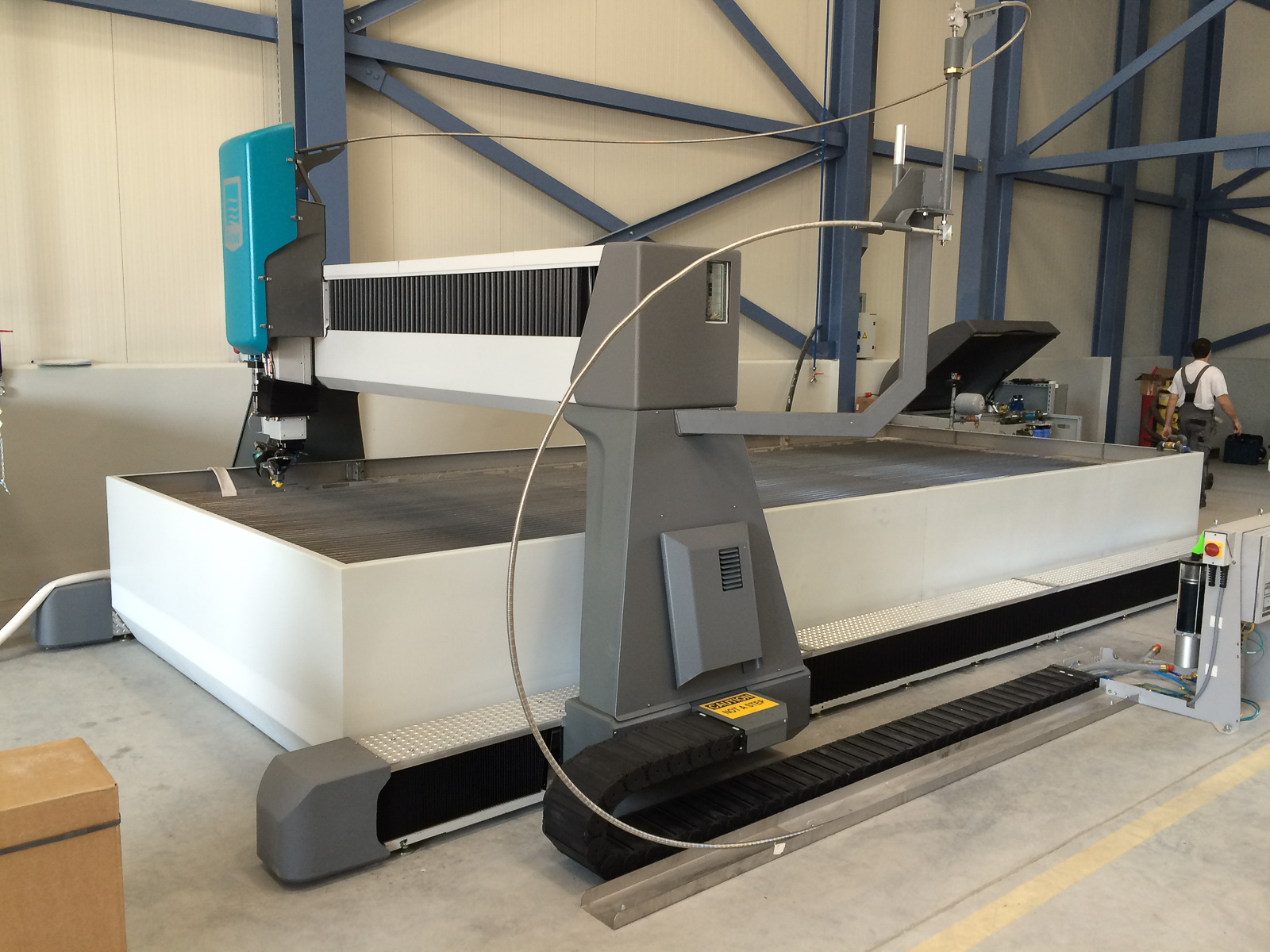
Waterjet cutting
Technological excellence.
Waterjet cutting is a process of cutting materials using an extremely fast (multiple times the speed of sound) jet of water at very high pressure. This jet is so powerful that it can cut a wide range of materials—from soft (foam, rubber, plastic, non-ferrous metals) to very hard (all types of steel, stone, marble, glass, ceramics, carbon fiber).
How does it work?
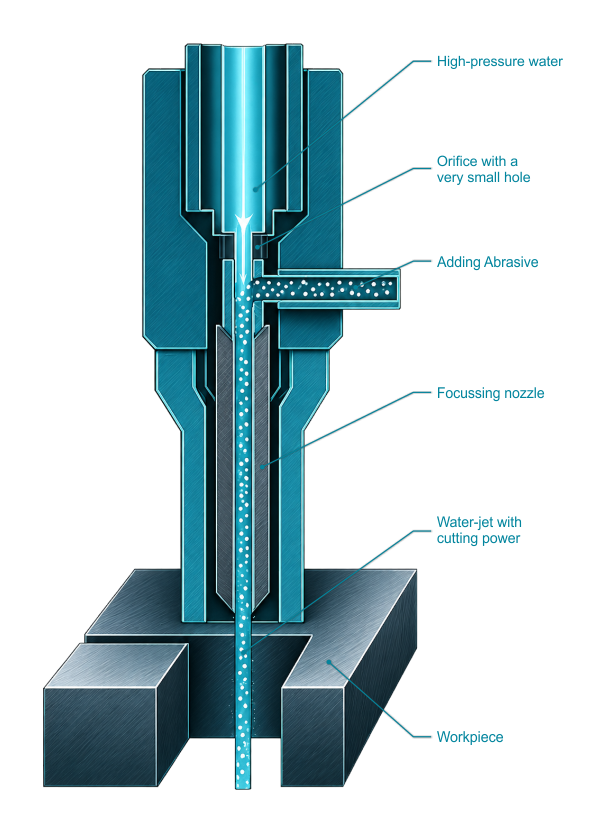
The process is quite simple and is based on the very high kinetic energy of water mixed with an abrasive medium:

The pump generates very high water pressure
Using a high-pressure pump, the water is pressurized to over 4,000 bar, creating extremely high kinetic potential.

The water is directed through a very small orifice
This creates a very thin (approximately 0.4 mm in diameter) and extremely fast jet of water, with a speed exceeding 2.5 times the speed of sound.

Adding abrasive
For all harder materials, a natural abrasive is added to the water jet to enable efficient cutting. Without abrasive, only softer materials can be cut — materials that could otherwise be cut with a knife or scissors; in this case, this is referred to as pure water cutting.

Material cutting
The abrasive mixed into the water jet removes material from the workpiece at high speed (similar to grinding), and with the help of a dynamic head that compensates for the jet taper, a clean, precise, square cut is produced. In this way, thin or thick materials of various types can be cut without heating, i.e., without a heat-affected zone.
Advantages
Compared to other processes (laser, plasma, mechanical cutting), waterjet cutting offers several key advantages:

No heat-affected zone
The material being cut does not heat up, so there are no thermal deformations, (micro)cracks, or changes in the material’s microstructure. The cut is clean and free of burn marks or slag.

Highly precise and clean cut
Enables fine details and smooth edges; the cut edge is square, and cut parts are often usable without additional processing or cleaning.

Cuts almost all materials
Wood, metals, stone/granite/marble, glass, ceramics, plastics, carbon fiber, various composites, rubber, or combinations of different materials.

No mechanical stress
There is no pressure, vibration, or high forces during cutting and clamping, so the material is not damaged or deformed.

The most environmentally friendly and clean process
Uses water and a natural abrasive; it does not use harmful cutting gases, and the process does not generate harmful UV radiation.
Waterjet cutting is an excellent choice when quality, precision, and versatility as well as an unchanged material microstructure are important.
Choosing cut quality is always a compromise between speed, cost, and the appearance of the final product.
Cut quality
Cut quality in waterjet cutting is typically classified from Q1 to Q5. A higher quality number means a smoother, more precise, and more aesthetic cut, but also slower cutting.

Q1
rough cut

- very fast cut
- the edge is rough, with visible deep grooves
- suitable for parts where appearance is not important
- suitable for fast separating very large thicknesses
Q2
basic quality

- still a relatively fast cut
- the edge is less rough, but the cut pattern is still visible
- for technical or internal parts
Q3
medium quality

- a good balance of speed and quality
- the edge is quite smooth
- suitable for most general products
- if there are no special requirements, this is usually the default quality
Q4
high quality

- very smooth and precise edge
- minimal cutting marks
- for visible and aesthetic products
Q5
highest quality

- exceptionally smooth, almost polished edge
- very slow cutting
- for the most demanding and decorative products
- highest cutting precision
Bevel (3D)cutting
On advanced machines such as the FLOW waterjet, which we also use at Nicrom, a special function is available for bevel (3D) cutting. This enables cutting at various angles, not only square (90°). For example, an edge can be cut square with an additional 45° bevel. These types of cuts are mainly used to prepare weld edges on welded assemblies, allowing the components to be produced in a single process and be ready for immediate assembly, without subsequent machining or finishing.
On our machine, the bevel cut angle can be tilted up to an extreme 60°. For such large tilts, we use custom-made mixing tubes.
How does it work?
The machine has a tilting cutting head (XD Dynamic Waterjet) that can move in multiple directions (so-called 5-axis cutting).
Cutting head:
- tilts left/right and forward/backward,
- automatically adjusts the angle according to the program,
- compensates for the natural cut taper.
This function is particularly useful in steel structures, mechanical engineering, and custom products, where precise angles and perfect part fit are essential.
Advantages:
- Precise angles (e.g., for welding or assembly)
- Better joints between material pieces
- Ability to create 3D shapes and complex geometries
- Perfectly square edges without taper (even on thicker materials)
- Sharp corners
Applications
Waterjet cutting is used in various industries where precision and high cut quality are important, or where the only requirement is that there is no heat input into the material being cut:
Metal industry
cutting metals, plastics, rubber, wood, and all other engineering materials
Automotive and aerospace industry
cutting specialty materials
Construction
cutting stone, granite, marble, ceramics, and tiles
Design and décor
unique patterns, lettering, and decorative elements
Glass industry
precise glass cutting without damage, with the option to cut very thick glass
In the aerospace industry, waterjet cutting is accepted as the only viable method for cutting sheet metal, because its heat-free nature does not affect the microstructure of the cut material. Due to its versatility, waterjet cutting is also an excellent solution for all technical and aesthetic products.
Waterjet cutting services
At Nicrom d.o.o., we provide waterjet cutting services on a modern machine from the leading manufacturer FLOW. The machine has a 6 x 2 m table and enables cutting of sheet materials up to 300 mm thick. It is equipped with an XD Dynamic Waterjet cutting head, which enables perfectly square cuts and sharp corners, as well as 3D cutting with a jet tilt of up to an exceptional 60°. The machine also enables piercing of harder and brittle materials with the VacuumAssist function. It features a plate unevenness compensation system, DynaBeam, which helps us ensure the highest possible accuracy of cut parts.